You’ve booked your summer whale watching tour in Vancouver, and you couldn’t be more excited to see humpback whales and killer whales in the beautiful Salish Sea. A truly special part of the tour is that not only will you see these stunning cetaceans, but you’ll often get to know them at an individual level.
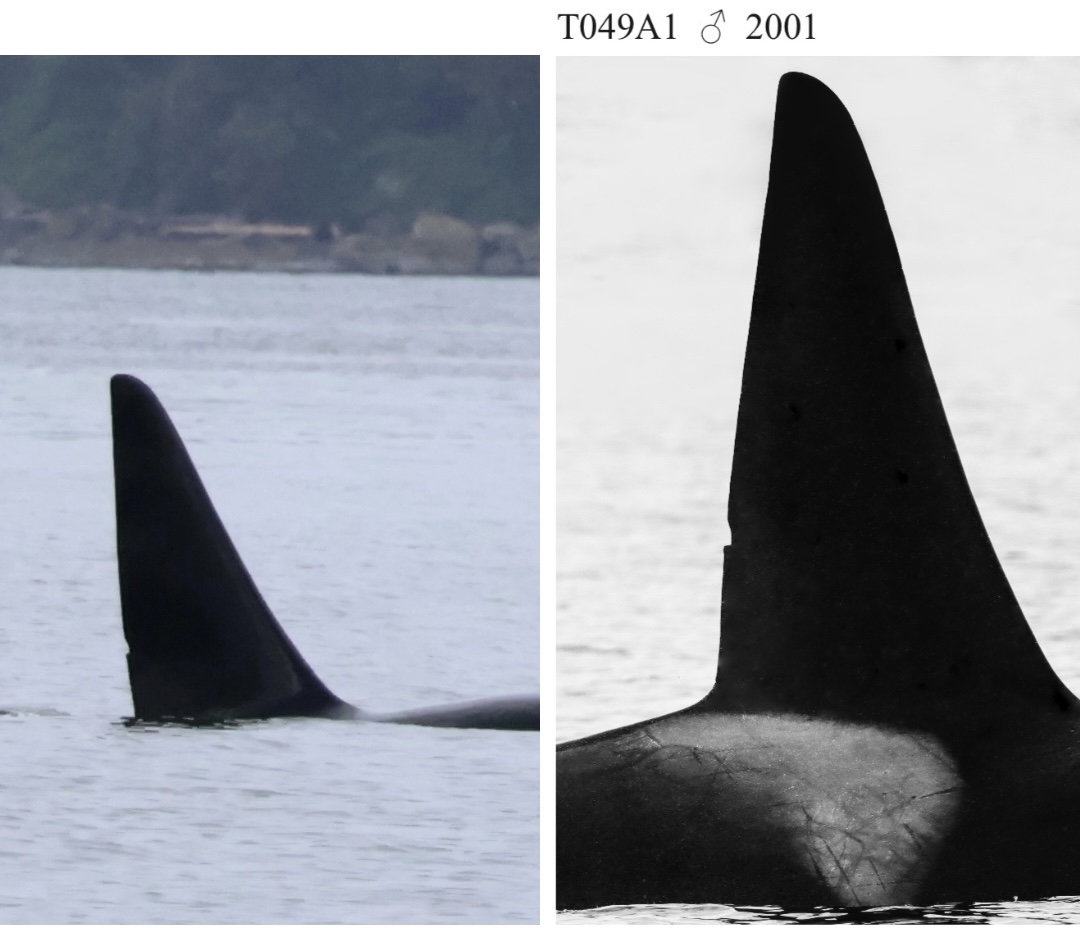
Every whale has unique markings on either their dorsal fins, saddle patches, or flukes that help us to identify them. For killer whales, these are often specific knicks on their dorsal fins. On our May 14th tour, we came across a single male traveling through the Gulf Islands. After some careful photo comparison between the camera and the photo ID guide books on board, we identified this whale as T49A1 Noah, a 25-year old male. If you look at the photo below, you can see the small notch on the lower half of his tall dorsal fin is particularly distinguishable.
Humpback whales can be easier to identify because of the unique patterns on their massive flukes. We categorize humpback whale flukes based on the light-dark ratio of their flukes—X-Whales have white pigmentation covering between 0%-20% of their tail, Y-Whales have 20%-80% white pigmentation, and Z-Whales have 80%-100% white pigmentation. Here, you can see BCX0519 Stitch with their all black fluke.
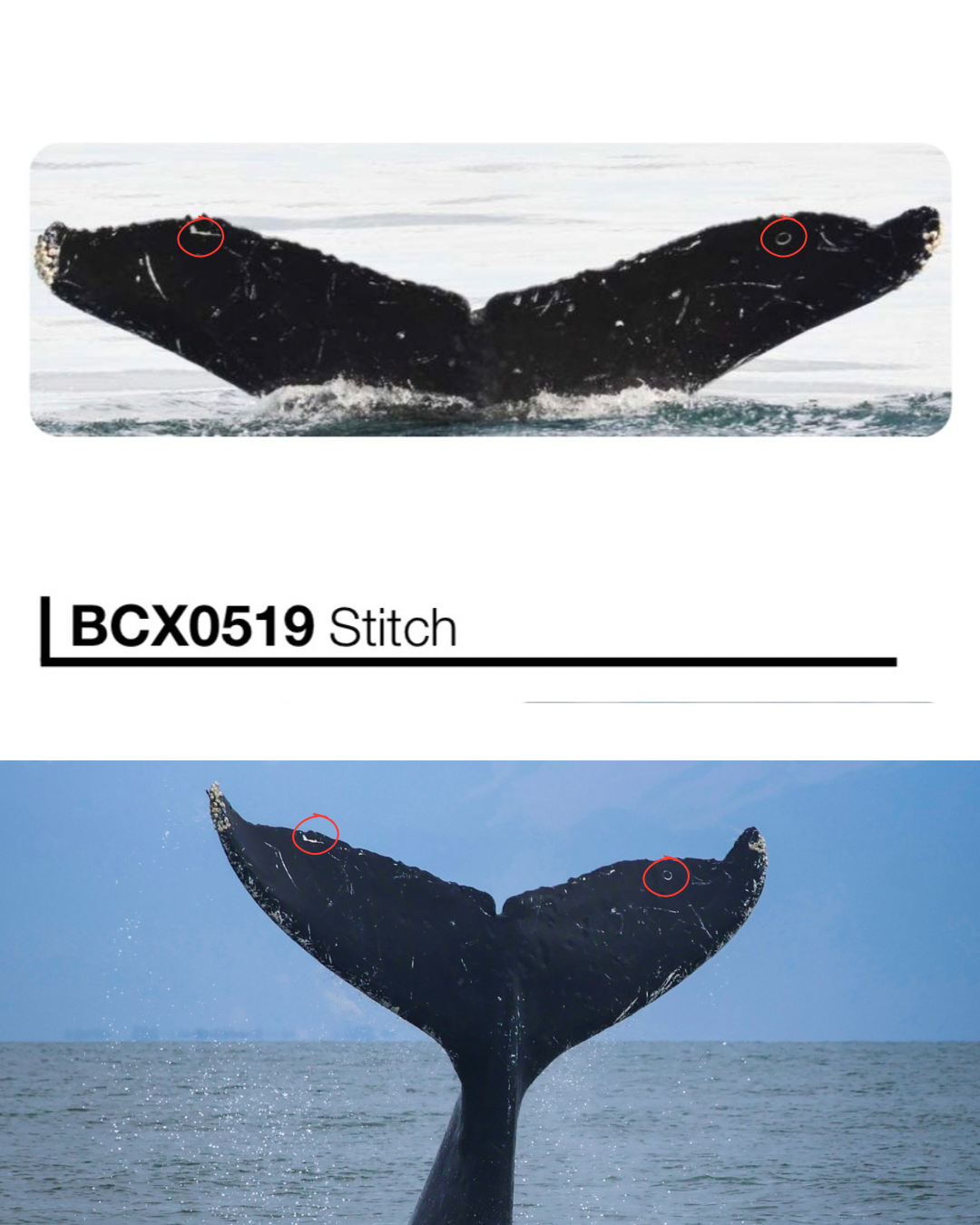
In the field, we’ll find unique markings on the fluke and match those to the images in the photo-identification guide books. We’ve circled some of Stitch’s most distinct markings so you can see it for yourself and practice!
Depending on their behaviour, humpback whales might not always be fluking when we encounter them. Luckily, it is still possible to identify them by their dorsal fins. Identifying humpback whales solely from their dorsals is tricky, as this part of their body has less defined markings compared to their flukes, but it’s still possible with time and practice.
Photo-identification serves many useful purposes. We can follow killer whale families for many decades, tracking births, deaths, and recording data to be used for research. We can also track humpback whales throughout their migrations, to determine if they migrate to either Hawaii or Mexico. For our passengers, it always makes a tour more special when you get to know the names of the whales you’re watching and learn more about their specific life histories.